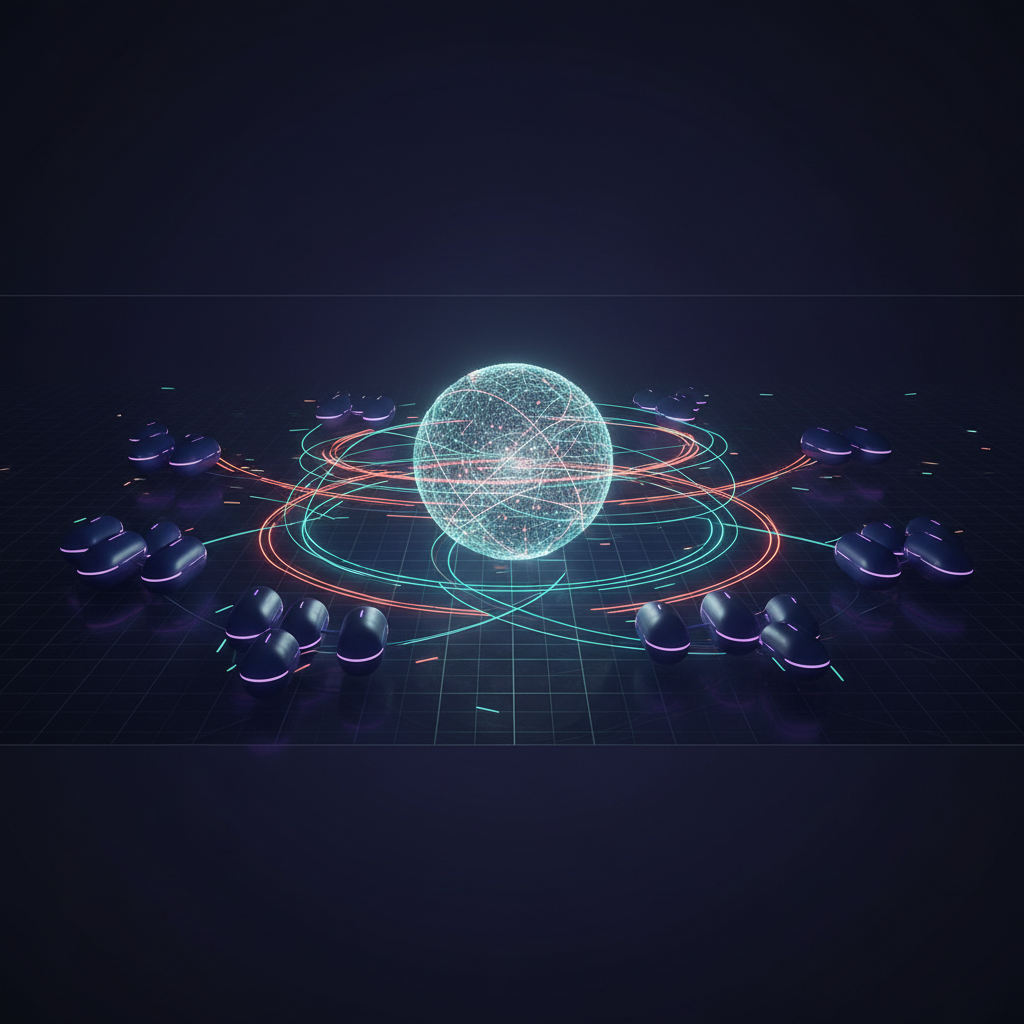
From Soloist to Symphony: Mastering LLM Orchestration with Multi-Agent Frameworks
In the world of generative AI, a single Large Language Model (LLM) can feel like a virtuoso—capable of composing text, answering complex questions, and even writing code with stunning proficiency. But ask that same virtuoso to manage a multi-stage software project, analyze real-time financial data, and draft a marketing campaign simultaneously, and you’ll find the limits of a soloist. The future of building complex, autonomous systems isn’t about finding a single, smarter model; it’s about effective LLM orchestration. This involves creating a collaborative ecosystem where multiple, specialized AI agents work together, much like a well-conducted orchestra. By leveraging multi-agent systems, we can move beyond simple Q&A bots to construct sophisticated applications that reason, plan, and execute tasks with unprecedented capability.
This comprehensive guide explores the shift from monolithic LLM applications to dynamic multi-agent architectures. We’ll examine why this approach is necessary, how these systems are structured, and the powerful role of tool calling in giving these agents real-world agency.
Why a Single LLM Isn’t Enough for Complex Tasks
The initial excitement around models like GPT-4 or Claude 3 led many to believe in a “one model fits all” solution. However, as developers build more ambitious applications, the constraints of a single-model architecture become apparent. Relying on one LLM for everything is like asking a single employee to be the CEO, lead developer, marketing manager, and customer support specialist.
Cognitive Overload and Diluted Expertise
A general-purpose LLM, while incredibly broad in its knowledge, lacks the focused depth of a specialist. When a single model is tasked with context-switching between disparate domains—such as parsing a legal document, then debugging Python code, then designing a user interface—its performance can become inconsistent. Each task requires a different “mental model,” and forcing a single LLM to juggle them all can lead to suboptimal, generic, or even incorrect outputs. A specialized agent, fine-tuned or prompted for a specific domain, will almost always outperform a generalist.
The Monolithic Maintenance Problem
In software engineering, we moved away from monolithic applications for good reasons: they are difficult to scale, debug, and update. The same principles apply to AI systems. If your entire application—from data analysis to user interaction to external API calls—is handled by one massive prompt to a single LLM, a failure in one part can bring down the whole system. A multi-agent approach, by contrast, modularizes the application. If the agent responsible for interacting with the Twitter API fails, the other agents (like the data analysis or reporting agents) can continue to function or handle the error gracefully.
The Core of Collaboration: Anatomy of an LLM Agent
Before orchestrating a team of agents, it’s essential to understand what constitutes a single agent. An “agent” in this context is more than just an LLM. It’s an autonomous entity designed to perform specific tasks. Its architecture typically consists of several key components that work in concert.
The LLM: The Agent’s Brain
At the heart of every agent is an LLM that provides the reasoning and language capabilities. This could be a frontier model like OpenAI’s GPT-4o, Google’s Gemini, or an open-source alternative like Llama 3. The choice of model often depends on the agent’s specific role; a creative writing agent might benefit from a highly fluent model, while a simple data-formatting agent could use a smaller, faster, and more cost-effective model.
Tools: The Agent’s Hands and Senses
This is where agents gain their power to interact with the world beyond text generation. Tools are external functions, APIs, or data sources that an agent can use. The mechanism that enables this is often called Tool Calling or Function Calling. It allows the LLM to recognize when a user’s request requires an external action, format a request for that tool, and then process its output.
- Data Retrieval Tools: Functions that query a database, search a vector store (for RAG), or fetch information from a public API (e.g., a stock price API).
- Action Tools: Functions that perform an action, such as sending an email, executing a piece of code in a secure sandbox, or posting a message to a Slack channel.
- Human-in-the-Loop Tools: A special tool that allows the agent to pause its execution and ask a human for clarification, approval, or additional input.
Memory: Providing Context and Continuity
For an agent to perform multi-step tasks, it needs a memory. This is often broken down into two types:
- Short-Term Memory: This is typically the conversation history within a single session. It allows the agent to remember what was just discussed and maintain context for the current task.
- Long-Term Memory: For more persistent learning, agents can be connected to external databases, often vector databases. This allows them to recall information from past interactions, learn user preferences, or access a vast knowledge base efficiently.
Architectural Patterns for Multi-Agent Systems
Simply creating a handful of agents isn’t enough; they need a structure to guide their collaboration. The way agents are organized and communicate defines the system’s capabilities. Several common architectural patterns have emerged for effective LLM orchestration.
1. The Hierarchical (Manager-Worker) Model
This is one of the most intuitive patterns. A central “Orchestrator” or “Manager” agent acts as a project manager. It receives a high-level goal, breaks it down into smaller, actionable sub-tasks, and delegates them to a team of specialized “Worker” agents.
- Example Workflow: A user requests, “Analyze our latest sales data, create a visualization of regional performance, and draft an email summary for the executive team.”
- The Orchestrator Agent breaks this down:
- Assigns “Query the sales database for Q2 data” to the Data Analyst Agent (using a database tool).
- Once complete, it sends the structured data to the Visualization Agent with the instruction “Create a bar chart of sales by region.”
- Finally, it provides the data and the chart to the Communications Agent and asks it to “Draft a concise email summary for executives.”
- Benefit: This model is structured, predictable, and easier to debug, as the flow of control is centralized.
2. The Collaborative (Roundtable) Model
In this pattern, agents act as peers in a shared environment, like a group chat. They can all observe the state of the problem and contribute their expertise iteratively. This model is excellent for complex, open-ended problems that benefit from diverse perspectives, such as brainstorming or research.
- Example Workflow: A prompt like “Develop a comprehensive digital marketing strategy for our new mobile app.”
- A Market Research Agent starts by pulling competitor data.
- The SEO Specialist Agent sees this data and suggests keywords and content ideas.
- A Social Media Agent critiques the ideas for platform suitability and proposes a content calendar.
- The process continues with agents building on, refining, and challenging each other’s outputs until a consensus or a final plan is reached.
- Benefit: Fosters emergent solutions and creativity that a rigid, top-down hierarchy might stifle.
3. The Sequential (Assembly Line) Model
This is a linear workflow where the output of one agent becomes the input for the next. It’s ideal for well-defined processes where each step is distinct and dependent on the previous one.
- Example Workflow: A CI/CD pipeline for generating code.
- Step 1: A Requirements Agent interacts with the user to produce a detailed technical specification.
- Step 2: A Coding Agent takes the spec and writes the corresponding Python code.
- Step 3: A Testing Agent receives the code, writes unit tests for it, and executes them.
- Step 4: If tests pass, a Documentation Agent generates docstrings and a README file.
- Benefit: Highly efficient and reliable for standardized, repeatable processes.
Frameworks and Libraries for Building Multi-Agent Systems
Building these systems from scratch is a significant undertaking. Fortunately, a growing ecosystem of open-source frameworks provides the building blocks for agent creation and orchestration.
LangChain
As one of the first and most mature frameworks, LangChain provides a comprehensive toolkit for building LLM applications. Its `LangChain Agents` module offers flexible abstractions for defining agents with tools, memory, and reasoning logic. It’s a powerful but sometimes complex choice, offering a high degree of customization.
Microsoft Autogen
Autogen is a framework specifically designed for creating conversations between multiple agents. It simplifies the process of defining different agent roles (e.g., `UserProxyAgent`, `AssistantAgent`) and setting up complex communication patterns between them. It excels at simulating the collaborative roundtable model discussed earlier.
CrewAI
CrewAI offers a more streamlined, role-based approach to building multi-agent systems. It focuses on defining a “crew” of agents, each with a specific `role`, `goal`, and set of `tools`. It then manages the orchestration process, promoting collaborative intelligence to accomplish a shared objective. Its design often makes it easier to get started compared to more low-level frameworks.
Implementation Challenges and Best Practices
While the potential of multi-agent systems is immense, their implementation comes with a unique set of challenges that require careful engineering.
Cost and Latency: Every time an agent thinks, plans, or uses a tool, it often results in an LLM call. In a system with five agents collaborating on a task, a single user request could easily trigger 10-20 or more API calls. This can become expensive and slow. A key best practice is to use a “model routing” strategy: use powerful, expensive models for high-level planning and reasoning, but delegate simpler tasks (like formatting JSON or running a simple script) to smaller, faster, and cheaper models.
State Management: Tracking the progress of a complex task across multiple asynchronous agents is difficult. What happens if the Data Analyst agent fails? Does the entire process halt? Robust state management and error-handling logic are critical. Systems need to be designed to be resilient, with mechanisms for retries, fallbacks, and human intervention.
Debugging and Observability: When a multi-agent system produces an unexpected result, tracing the cause can be a nightmare. Was it a faulty prompt for one agent? A misunderstanding between two agents? A bug in a tool? Implementing comprehensive logging and tracing (using tools like LangSmith or Helicone) is not an option; it’s a necessity for understanding and debugging agent behavior.
Frequently Asked Questions (FAQ)
What is the main difference between LLM orchestration and a simple RAG pipeline?
A Retrieval-Augmented Generation (RAG) pipeline is a specific pattern focused on retrieving relevant data to augment an LLM’s context for a single response. LLM orchestration is a much broader concept that involves coordinating multiple LLMs or agents to perform complex, multi-step tasks. A RAG pipeline can be a tool used by an agent within a larger orchestrated system, but orchestration also includes planning, delegation, and using other tools beyond data retrieval.
Is a multi-agent system always better than using one powerful LLM?
No, not always. For straightforward, single-turn tasks (e.g., “Summarize this article” or “Translate this sentence”), a single powerful model like GPT-4o is more efficient and cost-effective. Multi-agent systems shine when dealing with complex problems that require decomposition, specialized knowledge, or interaction with multiple external systems.
How does “Tool Calling” empower multi-agent systems?
Tool Calling is the bridge between the LLM’s reasoning and real-world action. It’s the fundamental mechanism that allows an agent to do more than just generate text. Without tools, agents are confined to their pre-trained knowledge. With tools, they can access live data, interact with software, execute code, and perform meaningful work, making them practical problem-solvers.
What developer skills are most important for building these systems?
A successful developer in this space needs a hybrid skill set. Strong Python programming is essential, along with a deep understanding of how to interact with APIs. Experience with LLM frameworks like LangChain or CrewAI is crucial. Perhaps most importantly, a solid foundation in software architecture and system design is needed to build reliable, scalable, and debuggable distributed systems.
Conclusion: Build Your AI Team, Not Just a Tool
The paradigm for developing advanced AI applications is shifting. We are moving away from treating LLMs as singular oracles and toward building well-orchestrated teams of specialized agents. This approach allows us to break down monumental tasks into manageable pieces, assign them to the right specialist, and combine their outputs into a cohesive and powerful result. LLM orchestration, powered by robust multi-agent systems and versatile tool calling, is the key to unlocking the next level of autonomous AI solutions.
Building these sophisticated systems requires a deep blend of expertise in AI, system architecture, and practical software engineering. If your business is looking to move beyond simple chatbots and develop a powerful, scalable AI solution that can tackle complex operational challenges, the expert team at KleverOwl is ready to help you design and build it. Explore our AI & Automation services to learn how we can bring your vision to life.