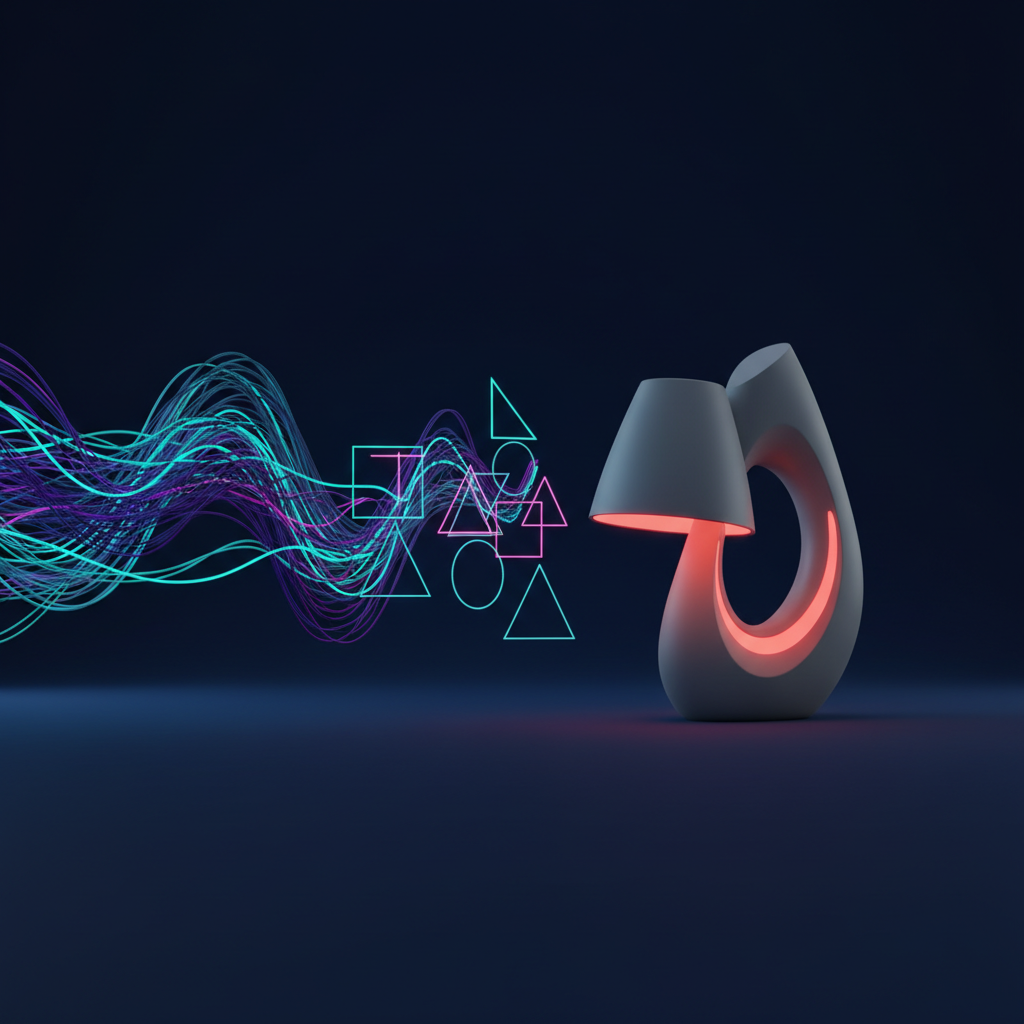
From Prompt to Product: How Generative AI is Reshaping Visual and Physical Design
Imagine describing a sleek, ergonomic office chair with chrome accents and a breathable mesh back to your computer, and within moments, seeing a detailed 3D model ready for prototyping. This scenario, once relegated to science fiction, is rapidly becoming a reality. The engine behind this transformation is Generative AI, a technology that is fundamentally altering the workflows of artists, graphic designers, engineers, and architects. It’s moving beyond simple automation to become a collaborative partner in the creative process, capable of generating novel concepts, intricate visuals, and even optimized physical product schematics from simple text prompts. This isn’t just about making things faster; it’s about expanding the very boundaries of what we can imagine and create.
Understanding the Engine: How Generative AI Creates
Before exploring its applications, it’s helpful to understand what makes Generative AI different from other forms of artificial intelligence. While traditional AI often focuses on analysis, classification, or prediction based on existing data, generative models are built to produce entirely new content that mimics the patterns and structures of the data they were trained on.
Diffusion Models: The Masters of Refinement
The technology powering most popular Text-to-Image tools like Midjourney and DALL-E is based on diffusion models. The process can be thought of as creation in reverse. The AI is first trained to take a clear image and systematically add digital “noise” until it becomes an unrecognizable static. Then, it learns to reverse this process: starting with random noise, it skillfully removes the noise step-by-step, guided by a text prompt, until a coherent image that matches the description emerges. This method allows for incredible detail and creative control, turning abstract concepts into vivid pixels.
GANs: The Creative Competitors
Another foundational technology is the Generative Adversarial Network (GAN). A GAN consists of two competing neural networks: a “Generator” and a “Discriminator.” The Generator creates new images, while the Discriminator’s job is to determine whether the image it’s seeing is a real one from the training data or a fake one created by the Generator. They are locked in a continuous feedback loop, with the Generator getting progressively better at creating convincing fakes and the Discriminator getting better at spotting them. This competitive dynamic results in the generation of highly realistic and original outputs.
The Visual Frontier: AI in Graphic Design, Art, and UI/UX
The most immediate and widespread impact of Generative AI has been in the domain of 2D visual creation. From marketing campaigns to user interface design, these tools are becoming indispensable for rapid ideation and asset creation.
Concept Art and Marketing at Lightning Speed
For creative teams, the “blank page” can be a formidable obstacle. AI design tools act as powerful brainstorming partners. A marketing team can generate dozens of unique visual concepts for a new ad campaign in a single afternoon by prompting an AI with themes, color palettes, and brand keywords. This dramatically shortens the ideation phase, allowing more time for refinement and execution. Concept artists for films and games can visualize entire worlds, characters, and props, iterating on ideas far more quickly than traditional sketching would allow.
Enhancing the UI/UX Workflow
The creation of user interfaces and experiences is also being streamlined. AI tools can now generate entire UI mockups from simple text descriptions or wireframes, providing a solid foundation for designers to build upon. Need a set of custom icons for a new feature? A designer can describe the style and function, and an AI can produce a consistent set in seconds. This allows UI/UX professionals to focus on higher-level concerns like user flow, information architecture, and usability testing, rather than getting bogged down in repetitive asset production.
Building the Tangible World: Generative AI in Physical Product Design
While images are impressive, the application of Generative AI to physical design and engineering holds profound implications for how we manufacture goods, construct buildings, and solve complex engineering problems.
The Next Evolution: Text-to-CAD
The bridge between a text description and a manufacturable 3D object is Text-to-CAD. This emerging technology aims to do for 3D modeling what DALL-E did for images. Engineers and industrial designers can describe a part—”a bicycle frame bracket to connect the seat tube and top tube, optimized for lightweight aluminum 3D printing”—and the AI generates a corresponding 3D model in a CAD-compatible format. While still in its early stages, tools like Luma AI’s Genie and various research models show immense promise. This will democratize 3D modeling, making it accessible to individuals without years of specialized CAD software training.
Generative Design: The AI Engineering Partner
In a more mature application, generative design software is already being used by leading engineering firms. Here, the process is goal-oriented. An engineer defines a problem by inputting a set of constraints and goals:
- Physics: Loads, pressures, and forces the part must withstand.
- Materials: Allowable materials, such as steel, titanium, or specific polymers.
- Manufacturing Methods: Constraints based on how the part will be made (e.g., 5-axis milling, injection molding, 3D printing).
- Cost: A target budget for production.
With these parameters, the AI explores thousands, or even millions, of design permutations, far more than a human team could ever consider. It often produces highly efficient, organic-looking shapes that are counter-intuitive but mathematically optimal for strength, weight, and performance. This leads to lighter, stronger, and more cost-effective components in aerospace, automotive, and medical industries.
A New Collaborative Workflow: The Designer as Director
A common fear is that AI will make human designers obsolete. The reality is more nuanced and, frankly, more interesting. The role of the designer is not disappearing but evolving from that of a hands-on creator to a creative director, curator, and strategist.
From Creator to Curator
In this new workflow, the designer’s most valuable skills are their taste, their deep understanding of the end-user, and their ability to guide the AI with insightful prompts. The AI can generate a hundred options, but it takes a human expert to identify the three that have true potential, to spot the subtle flaws, and to know which design best aligns with brand identity and project goals. The human provides the vision; the AI provides the rapid execution of possibilities.
Overcoming Creative Blocks
Generative AI serves as an inexhaustible source of inspiration. When faced with a creative block, a designer can use it to explore unconventional visual paths and break free from familiar patterns. By seeing a multitude of AI-generated starting points, a designer can spark new ideas, combine elements from different outputs, and push their own creativity in new directions.
Navigating the Challenges and Ethical Questions
The rapid adoption of these powerful tools is not without its complications. As a community of developers and designers, we must engage with the significant challenges that accompany this technology.
Copyright and Data Provenance
One of the most contentious issues is intellectual property. Who owns an AI-generated image? The person who wrote the prompt? The company that built the AI? The answer is legally murky and varies by jurisdiction. Furthermore, questions persist about the copyrighted data used to train these models. These legal battles are ongoing and will shape the commercial and ethical use of AI design tools for years to come.
The Risk of Aesthetic Homogeneity
If millions of creators are using the same handful of AI models trained on similar datasets, there’s a real risk that design trends could become homogenized. A distinct “AI look” might emerge, stifling the unique, personal styles that define great art and design. The antidote to this is creative prompting and extensive human post-processing and refinement, ensuring the AI is a starting point, not the final word.
Precision and Reliability
In the world of art, an AI “hallucination” like a person with six fingers is a strange quirk. In the world of Text-to-CAD, a structural flaw or an imprecise measurement could have catastrophic consequences. This underscores the absolute necessity of rigorous human oversight, validation, and testing, especially in engineering and manufacturing applications. The AI can suggest a form, but a qualified engineer must verify its function and safety.
Frequently Asked Questions (FAQ)
Will Generative AI replace human designers and engineers?
No, it is much more likely to augment them. It automates tedious tasks and accelerates ideation, freeing up professionals to focus on strategic thinking, problem-solving, and creative direction. The role will shift from pure execution to one of curation, prompt engineering, and systems thinking.
What is the key difference between Text-to-Image and Text-to-CAD?
The primary difference lies in the output. Text-to-Image generates a 2D raster or pixel-based image, like a JPEG or PNG, which is meant for visual consumption. Text-to-CAD generates a 3D model composed of precise geometric data (vectors, meshes, or B-Reps) that can be used in engineering software for analysis, simulation, and manufacturing.
Are designs created by AI protected by copyright?
This is a complex and evolving legal area. In the United States, the Copyright Office has generally ruled that works created solely by AI without sufficient human authorship are not eligible for copyright protection. However, these policies are being constantly challenged and refined, and the law varies internationally.
How can my business start using Generative AI for design?
A great way to start is by incorporating accessible AI design tools like Midjourney for marketing materials or concept exploration. For product-focused businesses, exploring the generative design modules within existing CAD software like Fusion 360 is a powerful next step. For custom implementations, consulting with experts is key to integrating the right models into your workflow.
Conclusion: Your Partner in the New Creative Era
Generative AI is not a fleeting trend; it is a fundamental shift in how we create. It acts as a powerful amplifier for human creativity, a tireless brainstorming partner, and a sophisticated tool for solving complex physical problems. From generating instant visual concepts for a mobile app to optimizing the design of a mission-critical machine part, its applications are as broad as our imagination. The key is not to view it as a replacement for human skill, but as a powerful co-pilot that enables designers and engineers to work smarter, faster, and more innovatively than ever before.
Navigating this new territory requires expertise and a forward-thinking approach. Whether you’re looking to integrate AI-powered features into your application, develop a next-generation product, or refine your user experience with intelligent tools, the team at KleverOwl is ready to help. Explore our AI & Automation solutions or UI/UX Design services to see how we can build the future together. Contact us today to start the conversation.