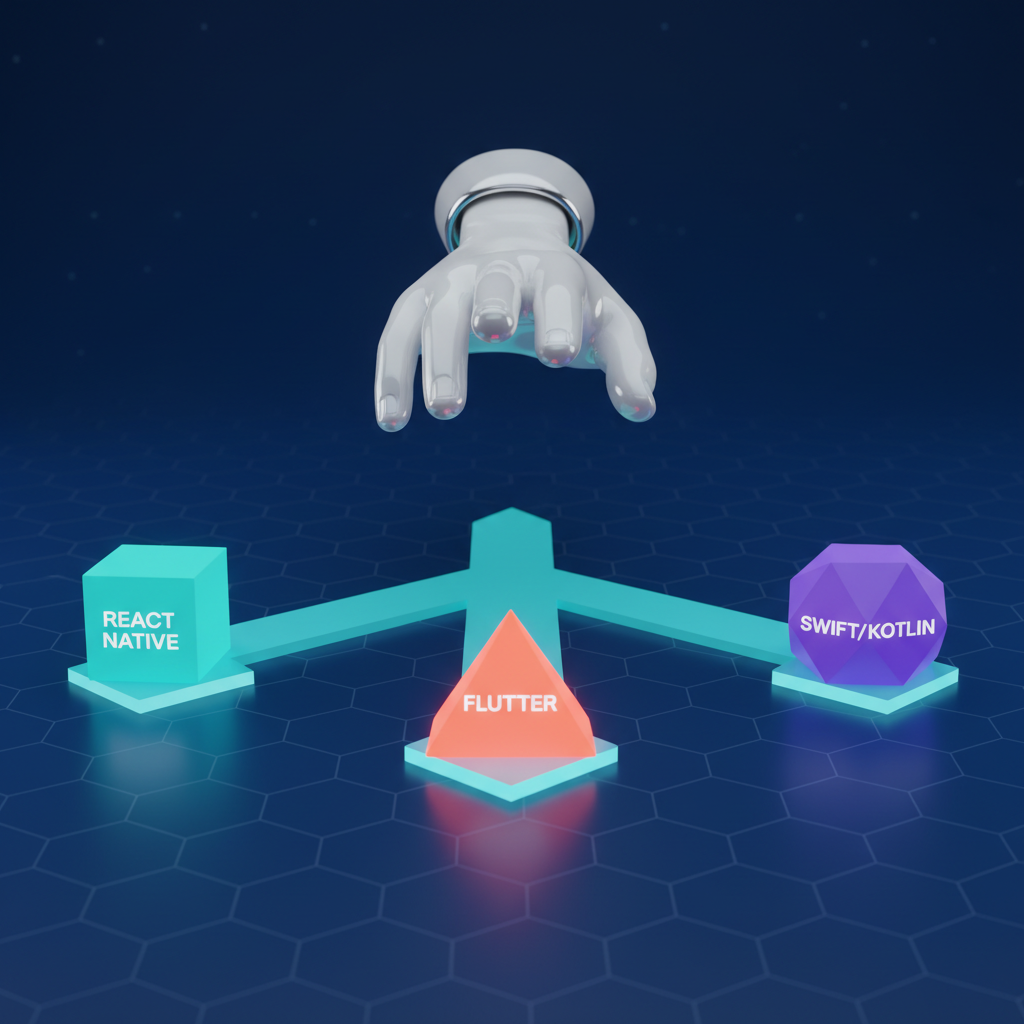
How to Choose the Right App Development Framework in 2026: A Definitive Guide
Selecting a technology stack for your mobile application is one of the most consequential decisions you’ll make. In 2026, with a hyper-competitive app market and rapidly evolving user expectations, this choice carries more weight than ever. The right decision can propel your app to success with stellar performance and scalability, while the wrong one can lead to costly rewrites and a product that feels dated on arrival. This guide is designed to help you navigate this complex process and choose an app development framework that not only meets your current needs but also future-proofs your investment for the years to come.
We’ll move beyond surface-level comparisons and explore the critical factors—performance, scalability, cost-efficiency, and long-term viability—that should inform your decision. This is your definitive app tech stack guide for building successful mobile products in 2026 and beyond.
The Foundational Choice: Native vs. Cross-Platform in 2026
The long-standing debate of native vs cross-platform development has matured significantly. By 2026, it’s less an ideological battle and more a strategic business decision based on project-specific requirements. Both approaches have clear, distinct advantages in the modern development environment.
Native Development (Swift & Kotlin): The Pinnacle of Performance
Native development involves writing separate, dedicated codebases for each operating system: Swift for iOS and Kotlin for Android. This approach allows developers to use the platform’s official tools and APIs directly, resulting in applications that are highly optimized for their respective devices.
- Unmatched Performance: Native apps communicate directly with the device’s hardware without any abstraction layers. This translates to faster execution, smoother animations, and superior responsiveness—critical for gaming, augmented reality, and apps with intensive data processing.
- Immediate Access to New Features: When Apple or Google releases a new OS feature, API, or hardware capability, native developers can integrate it on day one. This gives your app a competitive advantage by offering the latest and greatest user experiences.
- Optimal User Experience (UX): Native apps adhere strictly to the UI/UX guidelines of their platform. This creates a familiar, intuitive feel for users, reducing the learning curve and improving engagement. UI/UX design is crucial for this.
Choose Native if: Your application is a flagship product where performance is non-negotiable, it relies heavily on specific device hardware (like advanced camera functions or on-device AI processors), or you need immediate access to the latest OS updates.
Cross-Platform Development: Unifying Speed and Efficiency
Cross-platform frameworks allow you to write a single codebase that runs on both iOS and Android. This paradigm has evolved from a compromise to a powerful and viable option for a vast majority of applications.
- Significant Cost and Time Savings: The ability to maintain one codebase instead of two drastically reduces development hours and, consequently, project costs. It also streamlines the team structure, requiring a unified group of developers rather than two separate, specialized teams.
- Faster Time-to-Market: With a shared codebase, you can build, test, and launch your app on both platforms simultaneously. This speed is a crucial advantage for startups and businesses looking to validate an idea or capture market share quickly.
- Consistent Brand Experience: Cross-platform frameworks make it easier to maintain a consistent look and feel across different devices, reinforcing your brand identity.
Choose Cross-Platform if: Your primary goals are speed to market and budget control. It is the ideal choice for most business applications, e-commerce platforms, social media apps, and content-driven services where near-native performance is more than sufficient. For businesses looking to leverage existing web technologies, understanding why WordPress is still the #1 choice can also be beneficial.
Mobile Framework Comparison: The Leading Contenders of 2026
With the foundational choice made, the next step is selecting a specific framework. By 2026, the market has clear leaders, each with its own strengths. This mobile framework comparison highlights the best app frameworks 2026 has to offer.
Flutter: The UI-Centric Powerhouse
Developed by Google, Flutter has cemented its position as a top-tier framework. It uses the Dart programming language and compiles to native ARM code, bypassing the need for a JavaScript bridge. Its key feature is its rendering engine, Skia, which allows it to draw its own UI widgets, ensuring pixel-perfect consistency across all platforms.
- Strengths: Exceptional UI performance and visual fidelity, fast development cycles with stateful hot reload, and a single codebase that extends beyond mobile to web, desktop, and embedded systems. Google’s strong backing signals a robust future.
- Weaknesses: App binaries can be slightly larger than their native counterparts. The Dart ecosystem, while growing rapidly, is still smaller than JavaScript’s.
- Best for: Apps where a highly customized, branded user interface is a core feature. Its performance makes it suitable for a wide range of applications, from retail to fintech.
React Native: The Matured JavaScript Veteran
Backed by Meta, React Native leverages the world’s most popular programming language, JavaScript, and the widely adopted React library. Its 2026 iteration is built on a re-architected foundation (codenamed “Fabric”) that has addressed many of its historical performance limitations by enabling more direct communication with the native side.
- Strengths: A massive developer pool and an unparalleled ecosystem of libraries and tools. The ability to share code with a React web application can create huge efficiencies for businesses with a web presence.
- Weaknesses: Despite the new architecture, it still relies on a “bridge” to communicate with native modules, which can introduce overhead in highly interactive scenarios compared to Flutter. Achieving a perfectly native look and feel can require more platform-specific styling.
- Best for: Organizations with existing React expertise. It’s an excellent choice for content-driven apps, social platforms, and e-commerce apps where leveraging a vast JS ecosystem is a priority. This is the heart of the flutter vs react native debate.
Kotlin Multiplatform (KMP): The Pragmatic Hybrid
Kotlin Multiplatform is not a UI framework in the same vein as Flutter or React Native. Instead, it allows developers to share business logic, data models, and networking code written in Kotlin across platforms—including iOS, Android, web, and desktop—while building the user interface with fully native tools (SwiftUI for iOS, Jetpack Compose for Android).
- Strengths: It offers the “best of both worlds”: the cost-saving efficiency of a shared logic layer and the uncompromised performance and UX of a native UI. It’s an incremental approach, allowing teams to start sharing small parts of their code without a full rewrite.
- Weaknesses: It requires expertise in both native iOS and Android UI development, potentially increasing team complexity. The ecosystem for shared libraries is younger and less mature than its cross-platform counterparts.
- Best for: Complex applications where performance and native UX are paramount, but there’s still a strong desire to reduce code duplication in the business logic layer. It’s a fantastic choice for established companies migrating towards more efficient development practices.
Key Decision Factors for Your App Tech Stack Guide
To choose an app development framework correctly, you must evaluate your project against a clear set of criteria. Here are the most critical factors to consider in 2026.
1. Application Complexity and Performance Needs
What will your app do? If it involves 3D rendering, real-time data visualization, or heavy reliance on background processing and device sensors, the performance overhead of an abstraction layer could be a bottleneck. In these cases, Native or Kotlin Multiplatform are the safer bets. For the majority of applications—which primarily display data from APIs, collect user input, and have standard navigation—Flutter and React Native deliver more than enough performance.
2. Budget and Time-to-Market
This is often the most straightforward factor. If you are a startup or an enterprise launching a new product, getting to market quickly and efficiently is essential. Cross-platform frameworks like Flutter and React Native can realistically cut your development time and cost by 30-50% compared to building two separate native apps. If you have an established product and a generous budget focused on delivering a premium, best-in-class experience, the investment in native development can be justified. Understanding why clients trust KleverOwl can provide insight into our approach to these decisions.
3. Team Skills and Talent Availability
Consider the expertise of your in-house team or the talent you plan to hire. If your team is full of JavaScript and React experts, React Native is a natural and efficient choice. If your developers come from a Java or Kotlin background, they will find Dart (for Flutter) or Kotlin Multiplatform easy to adopt. Choosing a technology that aligns with your team’s skills reduces ramp-up time and development friction.
4. Long-Term Vision and Scalability
Think beyond the initial launch. Do you envision your application expanding to the web or desktop in the future? Flutter’s architecture is explicitly designed for this multi-platform future, making it a strong contender for ambitious projects. Consider also the scalability of the application itself. Will you be adding highly complex, platform-specific features down the line? A native or KMP architecture might provide more flexibility for integrating deeply with each OS as your app grows. Furthermore, exploring AI solutions and automation can significantly enhance scalability and user experience.
Future-Proofing Your Choice: AI, Declarative UIs, and Beyond
A forward-looking decision in 2026 must account for the dominant trends shaping software development. Choosing a framework that embraces these trends ensures your app remains relevant and easy to maintain.
The Rise of On-Device AI
AI is no longer a cloud-only feature. By 2026, users expect intelligent features that run directly on their devices for speed and privacy. Your framework must provide excellent, low-latency support for integrating on-device machine learning models via libraries like Core ML (Apple) and TensorFlow Lite (Google). Native development offers the most direct and performant access, but frameworks like Flutter are rapidly improving their support for these critical AI integrations. Integrating AI chatbots and data intelligence can also provide significant business advantages.
The Dominance of Declarative UIs
The imperative model of manually manipulating UI elements is a thing of the past. The modern paradigm is declarative: you describe what the UI should look like for a given state, and the framework automatically handles the updates. SwiftUI, Jetpack Compose, Flutter, and React all use this model. It leads to more predictable code, fewer bugs, and faster development. Any framework not built on a declarative foundation is a technical dead-end in 2026.
Frequently Asked Questions (FAQ)
Is React Native becoming obsolete by 2026?
Not at all. The massive JavaScript ecosystem, the vast pool of available developers, and the maturity of its new architecture ensure React Native remains a highly relevant and powerful choice. For companies already invested in the React ecosystem, it will continue to be the most efficient path to mobile.
What is the best framework for a startup in 2026?
For most startups, Flutter offers an ideal balance of high performance, rapid development speed, excellent UI capabilities, and cost-efficiency. Its ability to target multiple platforms from a single codebase makes it a very safe and powerful bet for getting a new product to market quickly.
Should I still learn native Swift and Kotlin development?
Absolutely. Native development skills are still the foundation of mobile. They are essential for building the highest-performance apps and are invaluable for debugging and optimizing cross-platform applications, as you often need to understand what’s happening under the hood. Expertise in native development will always be in high demand.
How is Kotlin Multiplatform (KMP) different from Flutter?
The key difference is the UI. Flutter is a complete, all-in-one framework that includes its own UI toolkit for building the entire application from a single codebase. KMP is not a UI framework; it’s a technology for sharing your non-UI code (the business logic). With KMP, you still build your user interface using the native tools for each platform (SwiftUI and Jetpack Compose).
Conclusion: Making the Right Choice for Your Project
There is no single “best” framework for every project in 2026. The optimal choice is a strategic decision that aligns with your specific business goals, technical requirements, and long-term vision. Cross-platform solutions like Flutter and React Native have matured into the default choice for a majority of projects, offering an incredible combination of speed, cost-efficiency, and near-native performance. Simultaneously, native development remains the undisputed king for applications that demand absolute peak performance and immediate integration of new OS-level technologies.
Making this decision can be daunting. You need a partner who understands the nuances of each framework and can guide you to the technology stack that will serve as a stable and scalable foundation for your app’s future. If you’re ready to build a high-performance, future-proof mobile application, the expert team at KleverOwl is here to help.
Contact us today to discuss your project and discover how we can turn your vision into a reality.