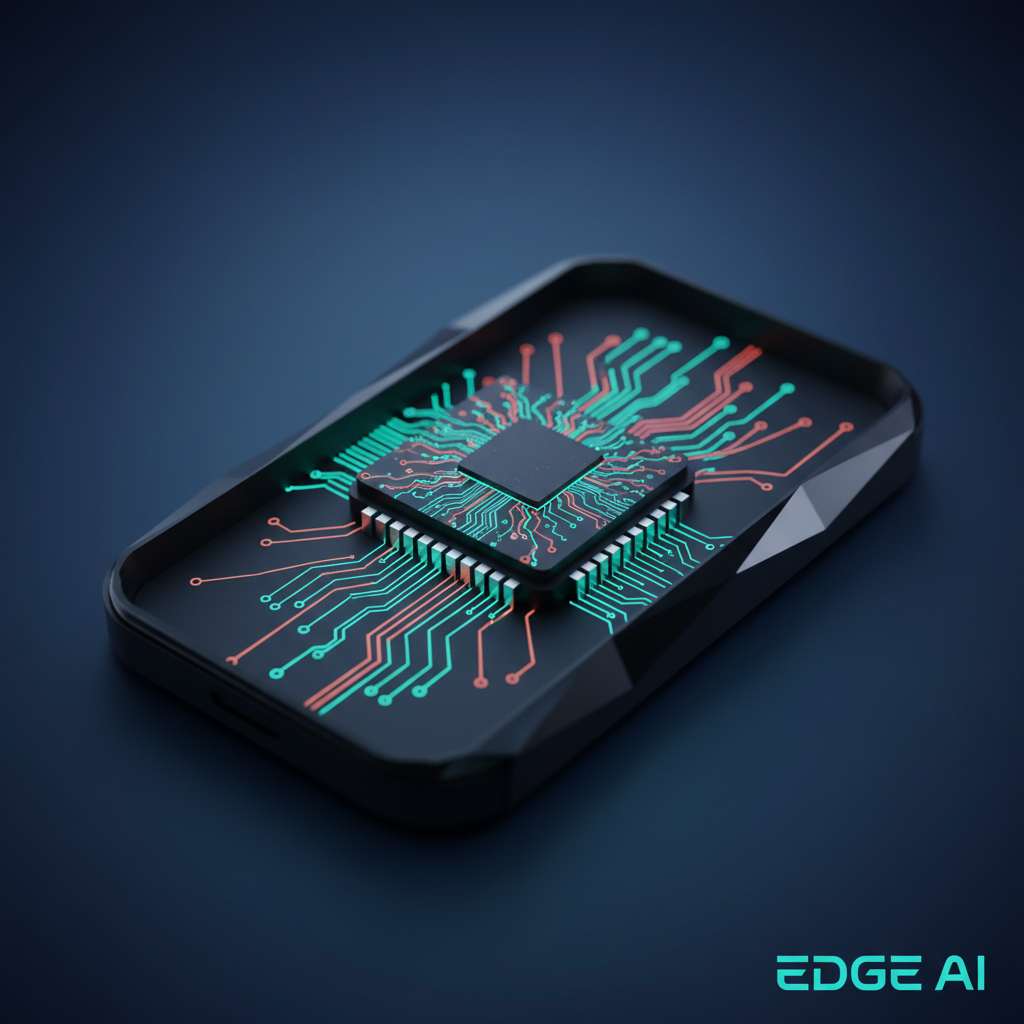
The Silent Revolution: How Edge AI and Specialized Hardware Are Redefining a Billion Devices
Pick up your smartphone. Unlock it with your face. Snap a photo and watch the background artfully blur in real-time. Type a message and see the next word predicted with uncanny accuracy. These aren’t cloud-powered miracles beamed down from a distant server farm. This is Edge AI in action, a quiet but profound shift in computing where intelligent processing happens directly on the device in your hand. This capability isn’t just a software trick; it’s the result of a deep, symbiotic relationship between sophisticated AI models and highly specialized silicon. The raw power needed for these tasks comes from dedicated hardware accelerators, custom-built to handle the unique demands of artificial intelligence. It’s a revolution happening not in the data center, but at the very edge of the network.
What Exactly is Edge AI? Moving Intelligence Out of the Cloud
For years, the prevailing model for AI was cloud-based. A device would capture data—a voice command, an image, a sensor reading—and send it to a powerful remote server for processing. The server, packed with high-performance GPUs, would run the AI model and send the result back. Edge AI fundamentally inverts this pattern.
Beyond the Data Center
Edge AI refers to the practice of running artificial intelligence algorithms locally on a hardware device, or “at the edge.” The “edge” can be a smartphone, a smart watch, an IoT sensor in a factory, a camera on a drone, or a computer in an autonomous vehicle. The processing, from data input to inference (the process of using a trained model to make a prediction), happens right where the data is generated. This seemingly simple change has massive implications for how we design and interact with technology.
The Core Benefits of On-Device Processing
- Low Latency: The most immediate advantage is speed. By eliminating the round-trip to a cloud server, the response time becomes nearly instantaneous. This is critical for applications like real-time object detection in a car’s safety system or interactive AR filters on social media. There is no waiting for a network connection; the result is immediate.
- Enhanced Privacy: In an era of heightened data privacy concerns, Edge AI offers a compelling solution. When data is processed on-device, sensitive information—like the biometric data for facial recognition or personal health metrics—never has to leave the user’s control. This builds user trust and simplifies compliance with regulations like GDPR.
- Improved Reliability & Offline Capability: An Edge AI application doesn’t need a constant internet connection to function. A smart security camera can still identify a person at the door during a Wi-Fi outage, and a mobile app can still translate text in a foreign country with no cellular service. This makes intelligent applications more robust and useful in a wider range of scenarios.
- Reduced Operational Costs: While the initial device cost might be higher, Edge AI can significantly lower long-term operational expenses. Continuously streaming data to the cloud consumes bandwidth and incurs significant processing costs. By handling tasks locally, companies can reduce their reliance on expensive cloud infrastructure.
The Engine Room: Why We Need Specialized Hardware Acceleration
Running a complex neural network is not like running a typical software application. The underlying mathematics, primarily vast numbers of matrix multiplications and other parallel operations, are a poor fit for a traditional Central Processing Unit (CPU). While a CPU is a brilliant generalist—adept at handling sequential instructions and complex logic to run an operating system—it becomes a bottleneck when faced with the massive parallelism of AI workloads.
CPUs vs. GPUs vs. NPUs: The Right Tool for the Job
To overcome this limitation, the industry turned to specialized processors. This is the core concept of hardware acceleration: offloading specific computational tasks to hardware designed explicitly to perform them efficiently.
- CPU (Central Processing Unit): The versatile master controller. Excellent for tasks requiring decision-making and executing varied instructions one after another. It manages the whole system but struggles with the repetitive, parallel math of AI.
- GPU (Graphics Processing Unit): The parallel workhorse. Originally designed to render 3D graphics, a GPU’s architecture consists of thousands of smaller, simpler cores designed to perform the same operation simultaneously on large blocks of data. This structure turned out to be exceptionally well-suited for training and running neural networks. For a long time, GPUs were the de facto standard for AI acceleration.
- NPU (Neural Processing Unit): The dedicated specialist. An NPU, also known as an AI accelerator or Tensor Processing Unit (TPU), is an Application-Specific Integrated Circuit (ASIC). It’s a piece of silicon engineered with one primary purpose: to execute the operations of a neural network at maximum speed and with minimal power consumption. It can perform trillions of operations per second while using a fraction of the energy of a CPU or GPU for the same task. This efficiency is the key that unlocked high-performance AI on battery-powered edge devices.
A Case Study in Silicon: The Apple Neural Engine
Perhaps no company has integrated specialized AI hardware into consumer products more effectively than Apple. The introduction of the Apple Neural Engine (ANE) in the A11 Bionic chip was a watershed moment, signaling a deep strategic commitment to on-device machine learning. It wasn’t just a component; it was a foundational piece of the Apple Silicon architecture.
How the Apple Neural Engine Works
The ANE is not a standalone chip that a developer addresses directly. Instead, it’s a co-processor integrated into Apple’s System on a Chip (SoC) alongside the CPU and GPU. Developers interact with it through high-level frameworks like Core ML. When an app needs to run an AI model, Core ML acts as an intelligent traffic cop. It analyzes the model and delegates different parts of the computation to the most efficient processor available:
- The CPU handles control flow and operations that the ANE or GPU can’t run.
- The GPU is used for massively parallel tasks that are a good fit for its architecture.
- The ANE is prioritized for the bulk of the neural network layers, as it can execute them with the highest performance and lowest power draw.
This unified architecture and intelligent delegation are what make on-device AI on iOS feel so seamless and responsive. It ensures that the system’s resources are used in the most efficient way possible, preserving battery life while delivering incredible performance.
Real-World Applications Powered by the ANE
The impact of the Apple Neural Engine is visible across the entire Apple ecosystem. It’s the hardware that enables:
- Face ID: Securely mapping and recognizing your face in fractions of a second.
- Live Text: Recognizing and interacting with text within images and the live camera feed.
- Computational Photography: Features like Portrait Mode, Deep Fusion, and Photographic Styles that process image data to produce professional-looking results.
- On-Device Siri: Processing many Siri requests locally for faster, more private responses.
- Predictive Keyboard: Suggesting the next word as you type with increasing accuracy.
The Broader Ecosystem of Edge AI Hardware
While Apple’s ANE is a prominent example, it’s part of a much larger industry-wide trend. The race to build the most efficient silicon for Edge AI is fierce, with major players developing their own specialized solutions.
Google’s Tensor and Qualcomm’s AI Engine
Google has taken a similar integrated approach with its Tensor SoC in Pixel smartphones. The onboard Tensor Processing Unit (TPU) is custom-designed to accelerate Google’s own AI models, powering exclusive features like Magic Eraser, which intelligently removes unwanted objects from photos, and extremely accurate on-device voice transcription.
Qualcomm, whose Snapdragon chips power a vast majority of Android devices, employs a heterogeneous computing approach with its AI Engine. It doesn’t rely on a single NPU but rather combines the strengths of its Kryo CPU, Adreno GPU, and its specialized Hexagon Digital Signal Processor (DSP) to accelerate AI workloads. This allows for flexibility and scalability across their entire range of mobile chips.
Beyond the Smartphone
The need for hardware acceleration extends far beyond phones. Companies like NVIDIA with their Jetson platform provide powerful, compact modules for robotics and autonomous machines. Google’s Coral offers accessible TPUs for prototyping and deploying AI in IoT devices. The automotive industry is another massive driver, with companies like Tesla and Mobileye designing custom chips to process the immense amount of sensor data required for self-driving capabilities.
Development Challenges and Considerations for Edge AI
Building applications that run on the edge presents a unique set of challenges and opportunities for software developers. It requires a shift in mindset from the resource-abundant world of the cloud to the constrained environment of a mobile or IoT device.
Model Optimization is Non-Negotiable
You cannot simply take a massive, high-precision AI model designed for a cloud server and expect it to run on a smartphone. The model must be optimized for the edge. This involves several key techniques:
- Quantization: This is the process of reducing the numerical precision of a model’s weights. For example, converting 32-bit floating-point numbers to 8-bit integers drastically reduces the model’s size and memory footprint, making it run much faster on NPUs, often with a negligible loss in accuracy.
- Pruning: This technique involves identifying and removing redundant or unimportant connections within a neural network, similar to trimming a tree. This makes the model “thinner” and less computationally expensive.
- Knowledge Distillation: Here, a large, complex “teacher” model is used to train a much smaller, more efficient “student” model. The student model learns to mimic the output of the teacher, capturing its essence in a more compact form.
Navigating a Fragmented Hardware Landscape
Unlike the standardized environments of cloud computing, the edge is a diverse ecosystem of different chips and accelerators. A model optimized for the Apple Neural Engine may not perform as well on Qualcomm’s AI Engine. This is where frameworks like TensorFlow Lite, PyTorch Mobile, and Apple’s Core ML become essential. They provide a layer of abstraction, allowing developers to build models that can be deployed across various hardware targets without having to write low-level code for each specific chip.
Power Consumption and Thermal Management
On an edge device, performance-per-watt is the most critical metric. An AI feature that drains the battery in 30 minutes is not a viable product. Developers must constantly balance model complexity with power efficiency. This is where specialized NPUs shine, as they are designed from the ground up to deliver maximum performance for minimal energy cost, preventing the device from overheating and preserving battery life.
Frequently Asked Questions about Edge AI
-
1. What’s the main difference between Edge AI and Cloud AI?
-
The primary difference is location. Cloud AI processes data on remote servers, requiring an internet connection. Edge AI processes data directly on the local device (e.g., a smartphone or sensor), which provides lower latency, better privacy, and offline functionality.
-
2. Is an NPU the same thing as a GPU?
-
No. While both are used for hardware acceleration, a GPU is a more general-purpose parallel processor, great for graphics and a wide range of AI tasks. An NPU (Neural Processing Unit) is a highly specialized processor built specifically for the mathematical operations common in neural networks, making it significantly more power-efficient for those specific tasks.
-
3. Do I need to be a hardware engineer to develop for Edge AI?
-
Not at all. While an understanding of the hardware’s capabilities is beneficial, developers primarily use high-level software frameworks. Tools like Apple’s Core ML and Google’s TensorFlow Lite handle the complex task of optimizing and running AI models on the appropriate hardware (CPU, GPU, or NPU), allowing developers to focus on the application logic.
-
4. Why is the Apple Neural Engine so significant?
-
Its significance lies in its early and deep integration into a mainstream, high-volume consumer product. It demonstrated the massive potential of on-device hardware acceleration and pushed the entire industry to prioritize developing specialized silicon for AI, popularizing features like Face ID and advanced computational photography that rely on it.
-
5. Is Edge AI only for mobile phones?
-
No, Edge AI is a broad concept that applies to any device outside of a traditional data center. This includes IoT devices in smart homes and factories, advanced driver-assistance systems (ADAS) in cars, medical imaging equipment in hospitals, and autonomous drones and robots.
Conclusion: The Future of a Smarter, More Responsive World
The convergence of powerful Edge AI models and specialized hardware acceleration is more than just an incremental improvement; it represents a fundamental shift in how we build intelligent applications. By moving computation from the centralized cloud to the distributed edge, we are creating a new class of software that is faster, more reliable, and inherently more private. The silicon inside our devices, from the Apple Neural Engine in an iPhone to the custom processors in a modern vehicle, is no longer just about raw speed but about efficient, intelligent processing.
Harnessing this power requires a nuanced understanding of both software optimization and the unique capabilities of the underlying hardware. It’s a challenge that demands expertise in creating efficient models and user experiences that feel instantaneous and intuitive. If you’re looking to build intelligent, responsive, and private applications that run on the edge, our team at KleverOwl can help.
Explore our AI & Automation solutions to see how we can bring on-device intelligence to your next project, or contact us today to discuss your unique vision.