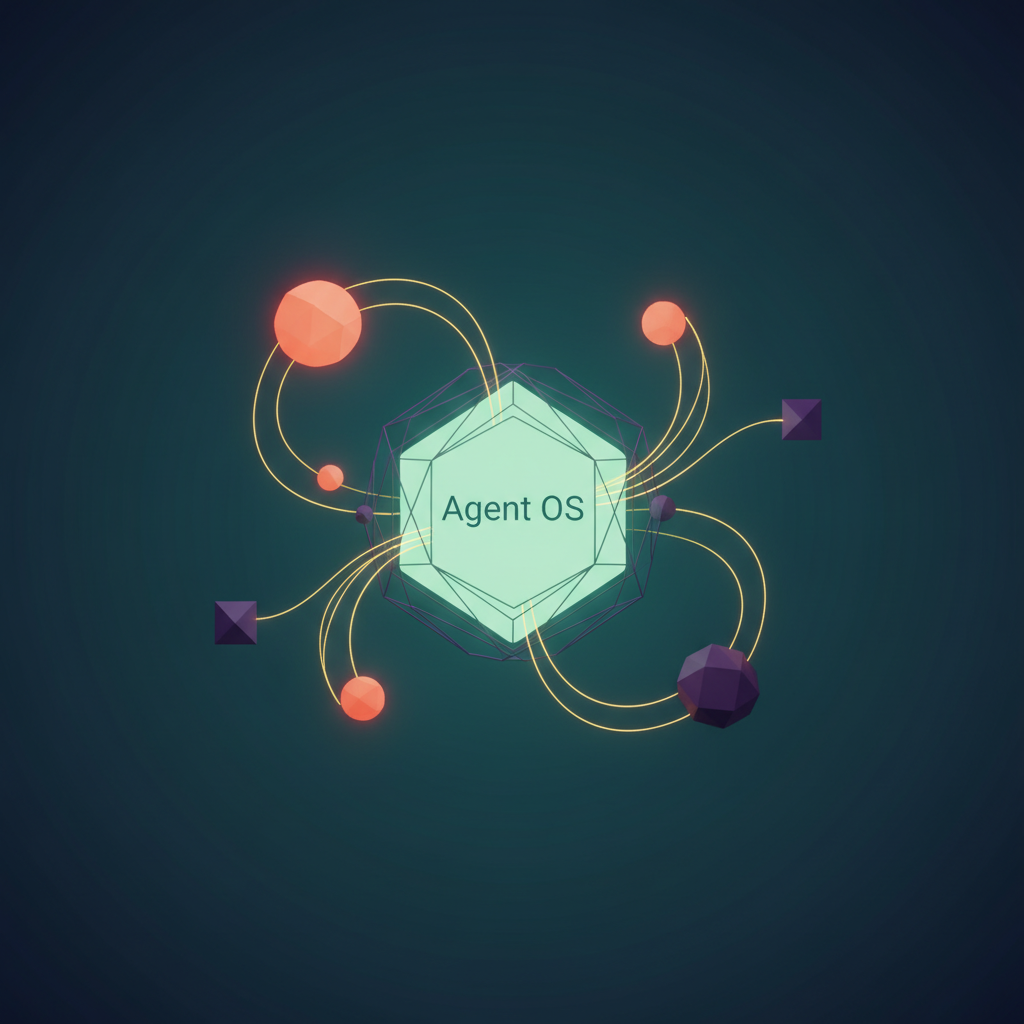
The Conductor and the Orchestra: Unpacking AI Agent OS and Orchestration
We’ve all become familiar with asking a chatbot a question and getting a direct answer. But what happens when the tasks are more complex? What if you could give an AI a high-level goal, like “plan and book a complete marketing campaign for our new product launch,” and it could assemble a team of specialized AIs to execute it? This is the future that AI agents are ushering in. We are moving beyond single-turn conversational tools toward persistent, goal-oriented systems. However, managing a team of autonomous agents introduces a new set of challenges that mirror those of traditional computing. This is where the concepts of an Agent Operating System (OS) and Agent Orchestration become not just important, but essential for building reliable and scalable AI solutions.
Beyond the Chatbot: What Defines an AI Agent?
Before we can manage them, we must first understand what makes an AI agent different from a standard Large Language Model (LLM) like ChatGPT. While an LLM is a powerful text prediction engine, an AI agent is a system built around an LLM, giving it capabilities for autonomous action.
An autonomous AI agent typically possesses four key attributes:
- Perception: The ability to take in information from its environment. This could be user input, data from an API, the content of a webpage, or feedback from another tool.
- Planning: The capacity to break down a high-level goal into a sequence of smaller, executable steps. It formulates a strategy to achieve its objective.
- Action: The ability to execute those steps by interacting with tools. These “tools” can be anything from a web browser, a code interpreter, a database connection, or another company’s API.
- Memory: The mechanism for storing and retrieving information from past interactions. This includes both short-term memory (context for the current task) and long-term memory (learnings from previous tasks) to improve future performance.
A simple example is a “research agent.” You don’t just ask it, “What are the latest trends in mobile app development?” You give it a goal: “Create a detailed report on the top 5 emerging trends in Android development for 2024, including market data, key companies, and future projections.” The agent would then plan its steps: search academic papers, browse tech news sites, query financial data APIs, synthesize the information, and finally, write the report. This ability to plan and act is what separates it from a simple Q&A model.
The Case for an Agent Operating System
When you have dozens or even hundreds of agents running concurrently, you need a foundational layer to manage them—just like your laptop needs Windows or macOS to manage its hardware and software. An agent operating system serves this exact purpose, providing the core infrastructure for agents to run securely and efficiently.
Core Functions of an Agent OS
- Resource Management: AI agents are resource-intensive. They consume API tokens, CPU cycles, and memory. An Agent OS is responsible for allocating these resources, preventing any single agent from monopolizing the system, and ensuring smooth multitasking.
- State & Memory Management: Complex tasks can take hours or even days. The OS needs to track the state of each agent—what it has done, what it plans to do next, and its current memory. It ensures that if a process is interrupted, it can be resumed without starting from scratch.
- Security and Sandboxing: Giving an autonomous AI access to your file system or company APIs is a major security consideration. An Agent OS creates secure sandboxes, enforcing strict permissions that define what tools an agent can use and what actions it is allowed to perform. This prevents a rogue or misguided agent from causing unintended damage.
- Inter-Agent Communication (IAC): For agents to collaborate, they need a standardized way to communicate. The Agent OS provides the underlying messaging protocols and channels that allow a “planning agent” to hand off a task to an “execution agent” seamlessly.
Agent Orchestration: Conducting the AI Symphony
If the Agent OS is the stage and the backstage crew, then agent orchestration is the conductor. Orchestration is a higher-level concept focused on managing the workflows and collaboration between multiple agents to accomplish a complex, multi-faceted goal. It’s less about low-level resource management and more about high-level strategy and coordination.
Imagine building a new web application. An orchestration engine might define a workflow like this:
- Goal: “Build a customer support portal for our e-commerce site.”
- Decomposition: The orchestrator breaks this down.
- Task 1: Define technical requirements and database schema. -> Assign to “Systems Architect Agent.”
- Task 2: Design the UI/UX based on brand guidelines. -> Assign to “UI/UX Design Agent.”
- Task 3: Write the front-end code in React. -> Assign to “Frontend Developer Agent.”
- Task 4: Build the back-end API. -> Assign to “Backend Developer Agent.”
- Task 5: Write unit and integration tests. -> Assign to “QA Agent.”
- Execution & Monitoring: The orchestrator triggers each agent in the correct sequence, passing the output of one agent as the input for the next. It monitors for errors—if the QA Agent finds a bug, the orchestrator can automatically re-assign a task back to the relevant developer agent with the bug report.
The orchestrator is the master planner, ensuring all the individual, specialized agents work together harmoniously to deliver the final product. Frameworks like CrewAI are excellent examples of this concept in practice, allowing developers to define agents with specific roles and goals and orchestrate them within a collaborative “crew.”
The Technical Stack of a Multi-Agent System
Understanding how these components interact is easier when you visualize them as a layered stack. Each layer builds upon the one below it.
Layer 1: Foundational Models & Tools
This is the bedrock. It consists of the core LLMs (like OpenAI’s GPT series, Google’s Gemini, or Anthropic’s Claude) that provide the reasoning “brain.” It also includes the collection of tools the agents can use: APIs for external services, web browsers, code interpreters, vector databases, and more.
Layer 2: The Agent Core
This is the implementation of a single AI agent. It contains the logic for its perception-planning-action loop (often using a framework like ReAct – Reason and Act). This layer is where the agent’s specific role, instructions, and personality are defined.
Layer 3: The Agent Operating System
The OS layer sits above the individual agents, managing their lifecycle, state, and access to resources. It provides the runtime environment where multiple agents can coexist and operate without interfering with one another.
Layer 4: The Orchestration Engine
At the very top, the orchestration engine defines and manages the multi-agent workflows. It dictates how agents are assembled into teams, how tasks are delegated, and how the overall objective is achieved through their collective effort.
Current Challenges on the Path to True Autonomy
While the potential is immense, building robust and reliable multi-agent systems is not without its difficulties. The industry is actively working to solve several key challenges:
- Compounded Errors: An LLM’s tendency to “hallucinate” or generate incorrect information is a known issue. In a multi-agent system, this problem is magnified. An error made by the first agent in a chain can be passed down and amplified by subsequent agents, leading to a completely flawed final output.
- Cost and Latency: Autonomous agents can make hundreds or thousands of LLM API calls to complete a single task. This can become prohibitively expensive and slow. Effective orchestration requires sophisticated logic for caching, cost tracking, and choosing the right model for the right sub-task (e.g., using a cheaper, faster model for simple steps).
- Observability: Debugging a system of non-deterministic, interacting agents is incredibly complex. When a workflow fails, pinpointing the exact agent, step, and reasoning that caused the error requires advanced logging and monitoring tools that are still in their infancy.
- Security and Containment: The primary function of an agent operating system is security, but it’s a difficult problem to solve. How do you give an agent enough power to be useful (e.g., write to a database) without creating a potential vulnerability? Defining and enforcing these boundaries is a critical area of research.
Frequently Asked Questions (FAQ)
What’s the main difference between an AI agent and a standard chatbot?
A chatbot is primarily reactive; it responds to your direct input and its operation is confined to that single interaction. An AI agent is proactive and goal-oriented. It can autonomously plan and execute a series of actions across multiple steps and tools to achieve a long-term objective you’ve assigned, often without requiring constant human intervention.
Is an “agent operating system” a real product I can use today?
The concept is still emerging, and we don’t yet have a dominant, commercially available “Windows for AI.” However, several open-source projects and platforms are building foundational components of an Agent OS. Projects like OpenDevin and frameworks like CrewAI and LangChain provide many of the necessary building blocks for state management, tool usage, and agent communication that are leading us toward a true agent operating system.
What programming languages and frameworks are used to build AI agents?
Python is by far the most dominant language in the AI space due to its extensive ecosystem of libraries and frameworks. Popular frameworks for building agents and orchestration logic include LangChain, LlamaIndex, CrewAI, and Autogen. These frameworks provide abstractions and tools that simplify interaction with LLMs, memory management, and tool integration.
How does agent orchestration handle tasks that require human approval?
This is known as a “human-in-the-loop” (HITL) workflow. A well-designed orchestration engine can build checkpoints into its process. For example, before an “Email Agent” sends a campaign to 10,000 customers, the orchestrator can pause the workflow and send a notification to a human manager for review and approval. The workflow only proceeds once that approval is given, combining the speed of AI with the judgment of a human expert.
Are autonomous AI agents a security risk for businesses?
Yes, they can be if not implemented correctly. An agent with unrestricted access to internal systems, APIs, or financial tools poses a significant risk. This is precisely why the security and sandboxing functions of an Agent OS are so critical. Businesses must implement strict permission controls, robust monitoring, and human oversight for any critical actions performed by an autonomous AI system.
Building the Future, One Agent at a Time
The transition from single-purpose AI tools to collaborative, multi-agent systems represents a fundamental shift in software development. It’s a move from writing explicit, step-by-step instructions to defining high-level goals and empowering autonomous systems to achieve them. The concepts of an agent operating system and agent orchestration are the essential architectural pillars that will support this new paradigm. They provide the structure, security, and management capabilities needed to turn the promise of intelligent, autonomous systems into a practical reality.
Navigating this complex new field requires a deep understanding of both AI architecture and robust software engineering principles. If your organization is looking to explore the power of AI agents or build sophisticated automation solutions, you need a partner with proven expertise. The team at KleverOwl specializes in designing and implementing advanced AI and automation systems that are secure, scalable, and tailored to your business goals. Whether you need a new web platform or a sophisticated mobile application powered by intelligent agents, we can help you build it right. Learn more about AI chatbots and their role in business intelligence.