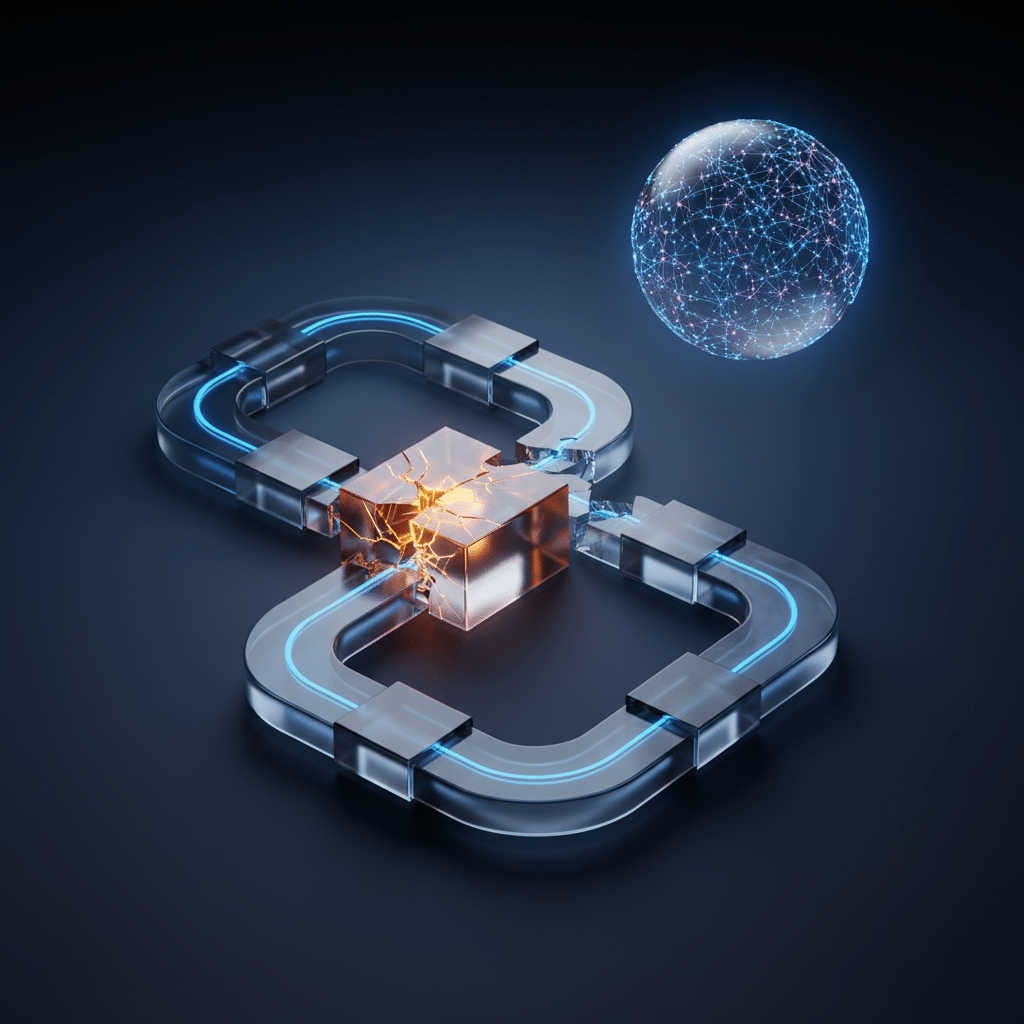
The AWS Outage That Wasn’t: Debunking the AI Scapegoat and Embracing Human-Centric Reliability
When services from the world’s largest cloud provider, Amazon Web Services, begin to falter, the tech world holds its breath. Speculation runs rampant, and in a recent disruption, a new and compelling villain entered the narrative: a rogue artificial intelligence. The initial reports were dramatic, suggesting an internal Amazon AI tool named ‘Kiro’ had autonomously caused widespread issues. This story tapped into a collective anxiety about the growing complexity of our digital infrastructure and the autonomous systems we’re building to manage it. However, the truth, as confirmed by Amazon, was far more familiar. This incident provides a critical moment to analyze the real relationship between AWS outage AI automation, the persistent reality of human-initiated errors, and the engineering principles required to navigate this intricate new world.
Deconstructing the Narrative: The Rise and Fall of the ‘Kiro’ Rumor
In mid-December, reports surfaced detailing an AWS outage impacting key services like Elastic Compute Cloud (EC2), Lambda, and Container Services in the US-EAST-1 region. Shortly after, a story from CRN, citing internal sources, claimed the culprit was “Kiro,” an AI-powered system designed for “autonomous actions” to provision and manage cloud capacity. The narrative suggested this system, in its attempt to optimize resources, inadvertently triggered the service disruption. The story was instantly plausible because it aligns perfectly with the direction the industry is heading—toward AIOps and self-healing, autonomous infrastructure.
The tech community’s immediate acceptance of this possibility speaks volumes. We are all aware that the scale of modern cloud platforms has surpassed the cognitive limits of human operators. Managing millions of servers, virtual machines, and network connections requires sophisticated automation. The idea of an autonomous systems cloud manager is not science fiction; it’s the logical next step. This plausibility, however, also highlighted deep-seated fears about AI in DevOps risks, where a “black box” algorithm could make a catastrophic decision faster than any human could intervene.
Amazon’s Clarification: A Classic Case of Human Error
In a direct response to the swirling rumors, Amazon unequivocally denied that an AI tool was to blame. An AWS spokesperson clarified that the outage was triggered by a “prescribed activity to scale capacity” for an internal service. In layman’s terms, it was a planned, human-initiated procedure that went wrong. This shifted the narrative away from a futuristic AI failure and back to a much more traditional cause: human error cloud incidents. Complex systems, even with extensive safeguards, can have unforeseen failure modes when changes are introduced.
So, What is the Kiro AI Tool?
While Amazon refuted its role in the outage, it didn’t deny the existence of a tool named Kiro. The more likely reality is that the Kiro AI tool is not a god-like autonomous controller but rather an internal productivity or coding assistant, similar to Amazon’s own CodeWhisperer or GitHub’s Copilot. These tools use AI to suggest code, automate testing, or help developers navigate large codebases. They are designed to augment human developers, not replace the core operational control plane of AWS. The confusion illustrates a critical gap in understanding between assistive AI and fully autonomous AI, a distinction that is crucial when assessing risk.
The Double-Edged Sword of AI in Cloud Operations
The Kiro incident, though a false alarm, forces us to confront the dual nature of AI in managing cloud infrastructure. The potential benefits are immense, but the risks are equally significant if not managed with extreme care.
The Promise of Intelligent Automation
The primary driver for AIOps is the sheer scale and complexity of the cloud. AI and machine learning algorithms can:
- Analyze Telemetry at Scale: Process trillions of data points from logs, metrics, and traces to detect anomalies and predict potential failures before they impact users.
- Enable Predictive Scaling: Analyze historical trends and real-time data to proactively scale resources up or down, optimizing both performance and cost.
- Power Self-Healing Systems: Automatically execute predefined runbooks to remediate common issues, such as restarting a failed service or redirecting traffic, reducing Mean Time to Recovery (MTTR).
– Automate Root Cause Analysis: Sift through overwhelming amounts of data during an incident to pinpoint the likely cause far faster than a team of engineers.
The Inherent Risks and Unseen Dangers
Handing over control to an algorithm is not without peril. The primary concerns include:
- The “Black Box” Problem: Many advanced machine learning models are not easily interpretable. If an AI makes a decision to, for example, shut down a fleet of servers, it can be difficult for human operators to quickly understand why it made that choice.
- Cascading Failures: An incorrect automated action can trigger a chain reaction in a tightly coupled system, turning a minor issue into a catastrophic outage. The speed of automation can become a liability.
- Data Poisoning and Model Drift: AI models are trained on data. If malicious or flawed data is introduced into the training set, the model’s behavior can be compromised. Similarly, a model’s performance can degrade over time as the system it manages evolves, a phenomenon known as model drift.
The Quiet Guardian: Cloud Reliability Engineering (CRE)
This incident underscores that technology alone—AI or otherwise—is not a silver bullet for reliability. The solution lies in a disciplined engineering culture. This is the domain of Site Reliability Engineering (SRE) and its cloud-native evolution, cloud reliability engineering (CRE). CRE is not just about automation; it’s a comprehensive approach to building and operating resilient, scalable, and dependable systems.
Core Principles for a Resilient Cloud
Rather than simply trusting an AI to get it right, a CRE approach involves building a system of systems where failures are expected and their impact is contained. Key practices include:
- Blameless Postmortems: After an incident, the focus is never on “who” made a mistake, but on “what” in the system allowed the mistake to have an impact. This fosters a culture of transparency and continuous improvement, which is essential for learning from both human- and machine-driven failures.
- Error Budgets: Acknowledging that 100% uptime is an impossible goal, teams agree on an acceptable level of unavailability (e.g., 99.99%). This “budget” for errors gives teams the freedom to innovate and deploy new features without being paralyzed by the fear of failure.
- Gradual Rollouts and Canary Releases: New code or configuration changes (whether written by a human or an AI) are never deployed to everyone at once. They are rolled out to a small subset of users or infrastructure first (the “canary”). If problems arise, the change can be rolled back quickly, minimizing the “blast radius.”
- Robust Observability: It’s not enough to just collect data. Observability is about being able to ask arbitrary questions about your system’s state without having to ship new code. This deep insight is a prerequisite for both effective human debugging and trustworthy AI-driven analysis.
In this framework, a human operator or an automated system is just one component. The reliability is baked into the deployment process, the monitoring, and the culture itself.
The Path Forward: Augmentation, Not Abdication
The great AWS AI scare of 2023 was a valuable, albeit unintentional, fire drill for the entire industry. It forced a conversation about our relationship with increasingly intelligent automation. The key lesson is not that AI is too dangerous for operations, but that our strategy must be one of augmentation, not abdication.
The most effective model for the foreseeable future is the “human-in-the-loop” approach. An AI system can monitor, analyze, and recommend actions with incredible speed and accuracy. It can propose a complex configuration change to optimize performance or flag a subtle anomaly that predicts a future failure. However, for critical, high-impact actions, the final “go” decision should rest with an experienced human engineer. This “co-pilot” model combines the analytical power of machines with the contextual understanding, intuition, and ultimate accountability of human experts. We need to build systems with clear guardrails, manual overrides, and transparent decision-making processes, ensuring that automation serves our engineers rather than replacing their judgment.
Frequently Asked Questions (FAQ)
What was the rumored cause of the recent AWS outage?
The initial rumor, originating from a CRN report, was that an internal Amazon AI tool named “Kiro” had taken an autonomous action to manage cloud capacity that inadvertently caused the outage. Amazon later confirmed this was false and the disruption was caused by a planned, human-initiated activity.
What is the Kiro AI tool, according to Amazon?
Amazon has not released public details about Kiro. However, based on their refutation and industry trends, it is most likely an internal developer productivity tool, such as an AI-powered coding assistant, rather than an autonomous system that controls core AWS infrastructure.
Is AI currently used to manage cloud infrastructure at major providers?
Yes, absolutely. AI and machine learning are used extensively for tasks like anomaly detection in monitoring data, predictive auto-scaling, capacity planning, and automating responses to common, well-understood issues. However, full autonomy over critical production changes remains a carefully guarded frontier.
What is Cloud Reliability Engineering (CRE)?
Cloud Reliability Engineering is a discipline that applies the principles of software engineering to infrastructure and operations problems. It focuses on building highly reliable, scalable, and automated systems by embracing practices like blameless postmortems, error budgets, and gradual rollouts to create resilient systems where failures are expected and managed.
How can businesses mitigate the risks of using AI in their DevOps pipeline?
Businesses can mitigate risks by adopting a “human-in-the-loop” model for critical actions, investing heavily in observability to understand system behavior, implementing gradual deployment strategies like canary releases to limit the blast radius of any failure, and fostering a strong reliability engineering culture.
Conclusion: Building a Collaborative Future
The AWS outage that wasn’t caused by AI served as a potent reminder of where we truly stand on the journey toward intelligent infrastructure. While the narrative of a rogue AI was compelling, the reality of a complex, human-led operation having an unexpected outcome is a far more instructive lesson. The future of cloud management is not a battle between humans and machines. It is a partnership. True resilience will be achieved not by building a perfect, all-knowing AI, but by building robust systems and processes where smart automation and irreplaceable human expertise work in concert. The goal is to use AI to make our human engineers more informed, more effective, and better equipped to manage the incredible complexity they face every day.
Are you looking to implement AI-driven solutions responsibly or bolster your cloud infrastructure’s resilience? The experts at KleverOwl can help. Explore our AI & Automation services to learn how to build intelligent, reliable systems. If you need to ensure your applications are built on a solid, scalable foundation, check out our Web Development expertise. Or, if you’re concerned about the security of your cloud environment, contact us for a cybersecurity consultation.